Mastering DDR5 Memory Scaling: Insights from X870 and Z890 Chipset Platforms with Kingston Fury Renegade
- Dhinak A.

- Nov 26, 2024
- 4 min read
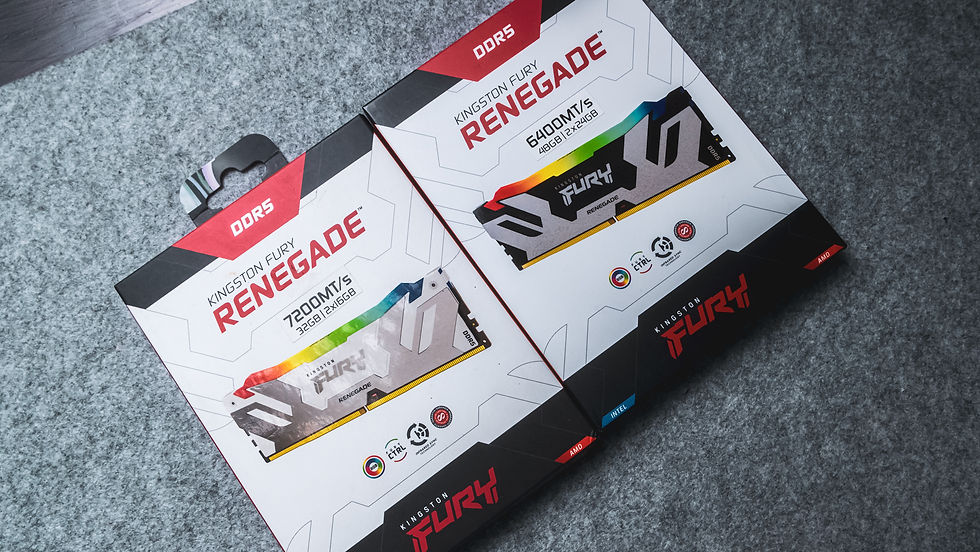
With the launch of the all new AMD X870 and Intel Z890 chipsets, memory and its properties have been altered to further suit these new platforms. DDR5 memory scaling is affected by the quality of your IMC ( integrated memory controller), the motherboard, and its UEFI BIOS firmware, as well as underlying tuning and board topology as the arrangement of connections between the memory modules and the memory controller on a computer's motherboard will differ from brands and models. The final element that one has to take note of is one has to take account of each kit of memory and all applicable elements, including the PMIC, PCB, and critically the IC which there are three of (Micron, Samsung, and SK Hynix).
For the majority of consumers, many feel that overclocking is always guaranteed if you have the XMP or EXPO profiles available. However, this is not precisely the case and true, as manufacturers have stated that for overclocking to be successful, there are certain variables that have to be met to even attempt overclocking in the first place. These variables are the number of slots/DIMMs per channel and memory density. It is also good news that for these new generations of platforms, the maximum memory divider has increased to 6400MHz on Intel and 5600MHz on AMD.

So you may now question, does XMP or EXPO guarantee overclockability? The answer is no, plain and simple. XMP or EXPO only validate the memory kit themselves, as there is no guarantee that the overall settings you are attempting to run are going to be supported by the platform. This is especially true when the quality and manufacturing of the IMC is concerned as it is a key variable factor of DDR5 scaling. The truth of the matter is that some CPUs will scale higher while some will face lower scaling. This is fundamental to overclocking as the entire process is pretty much a gamble.
In relation to that, one may ask what actually influences memory scaling when overclocking via XMP or EXPO? The answer to this question is related to a couple of factors as listed below :
The motherboard and its maximum supported memory speed.
The memory kit and its pre-validated XMP/EXPO profiles.
Population of the slots (2 DIMMs scales better than 4 DIMMs).
Density (16GB/32GB Capacity, the larger the capacity the more challenging it gets to achieve stability)
Integrated Circuit(IC)(Micron, SK Hynix, Samsung)
Kingston Technologies were happy to provide multiple memory kits for us to conduct a couple of tests and come up with a review of the entire process. They furnished us with their latest and best Kingston Fury Renegade memory kits ranging from 16GB-48GB memory kits of various speeds and also a 1TB Kingston Fury Renegade NVME drive for a fresh installation of Windows for this particular experiment to ensure overall consistency and control.

Evidently, after months of experimenting, tuning and hard labor we managed to come to a couple of conclusions. Our first conclusion is that with these new platforms, one can still run on 4 DIMMs (to achieve a higher density) but not at its pre-validated XMP/EXPO profiles. This is largely due to the fact that currently in the market, there are no 4 DIMM memory kits to be found. You have only 2 DIMM kits and the likelihood of running 4 DIMMs will mean that you have paired 2 kits of the same product. Yes, you can achieve better scaling by making sure the kits are of the same batch and run on a sequential serial number to get better results but chances are that you will be required to manually configure timings and what not. This in return proves that the profiles of the kit are redundant and your best bet is to just run at its JEDEC timings.
Our second conclusion is with regards to overclocking. Overclocking via populating 2 DIMMs yields the greatest results in terms of scaling higher. Higher speeds that are possible include 7400MHz - 8400MHz. Achieving such speeds does however require a higher quality IMC than usual. Additionally 2 DIMM motherboards such as the MSI Z890 Unify-X will also have a superior likelihood of success with the same CPUs.
Contrastingly, having kits with higher speeds validated by their profile has a lower gain when it comes to overclocking. What do we mean by this is that for kits which have a profile of 7400Mhz, one will probably be able to achieve speeds of up to 8000MHz++ whereas the gains from a 6000MHz kit will be in the region of 7000MHz - 8000MHz++. So do not presume that you would be able to overclock a 7400MHz memory kit all the way up to 10,000MHz!

Lastly, it is worthy to note that memory scaling and stability has drastically increased and become more efficient with these new platforms in contrast to when it was the early adopters phase for DDR5 memory. Additionally, for best possible outcomes and scenarios it is worth to look at what Kingston has to offer. Kingston has an extensive product lineup that surely will be on QVL lists of components.
Glossary of Terms
IMC (Integrated Memory Controller): A component within the CPU responsible for managing communication between the processor and memory modules. Its quality directly affects memory performance.
Topology: The arrangement and design of memory traces on a motherboard, influencing how efficiently signals travel between the memory modules and the IMC.
UEFI BIOS: The firmware interface on a motherboard that initializes hardware during boot and allows users to configure settings such as memory timings and voltages.
DIMM (Dual Inline Memory Module): A type of memory module used in desktops. Commonly comes in configurations of 2 or 4 DIMMs.
IC (Integrated Circuit): The memory chip on a module, manufactured by companies like Micron, Samsung, or SK Hynix, which determines performance characteristics.
JEDEC: A standard-setting body for memory specifications. JEDEC timings are baseline settings for stability.
XMP/EXPO Profiles: Pre-configured memory settings provided by the manufacturer to optimize performance for Intel (XMP) or AMD (EXPO) platforms.
QVL (Qualified Vendor List): A list of components tested for compatibility with a specific motherboard.
DDR5: The fifth generation of Double Data Rate (DDR) memory, offering higher speeds and better efficiency than previous generations.


Comments